On today's stream, I work on Airships, Staxel, a new RF track, and finish up with some previews of upcoming albums like Interstellar Rift, and a new Orchestral/Choral concert piece.
Monday, October 3rd Twitch Stream
I recently have had a lot of success using LoopBack to route audio from Logic to OBS, and so I've finally gotten to the point where I can start streaming again. The usual caveats apply: I'm not 100% sure that I can stick to any sort of schedule and often, the technical requirements of running 40-50GB of samples in my template can make streaming impossible, but I had a fun time this morning and would love to keep it up.
My next planned streaming day is Wednesday, October 5th, in the morning-ish time, MST. Hope to see you there!
New Concert Works Page Up!
For some time I've been meaning to set up a page for my "serious" concert music-- with the rebuilding of the home page this weekend, I've finally gotten around to doing it. At that link, you'll find some of my latest concert music, including an SATB setting of Byron's She Walks in Beauty, Like the Night.
The synthetic renderings on unperformed works aren't the best-- they aren't the worst either-- but I don't really have time to go into my DAW and program several 7-to-20-minute orchestral works, so I've instead rendered them using NotePerformer, which is one of the best Sibelius sound-sets I've come across. (Thanks to B.J. Derganc for the recommendation!)
I've also included perusal scores so that you can read along-- nothing too out of the ordinary.
If you or your ensemble are interested in performing them, drop me a line! I'll probably let you do it for (gasp!) free!
"I don't do much else. I just write music."
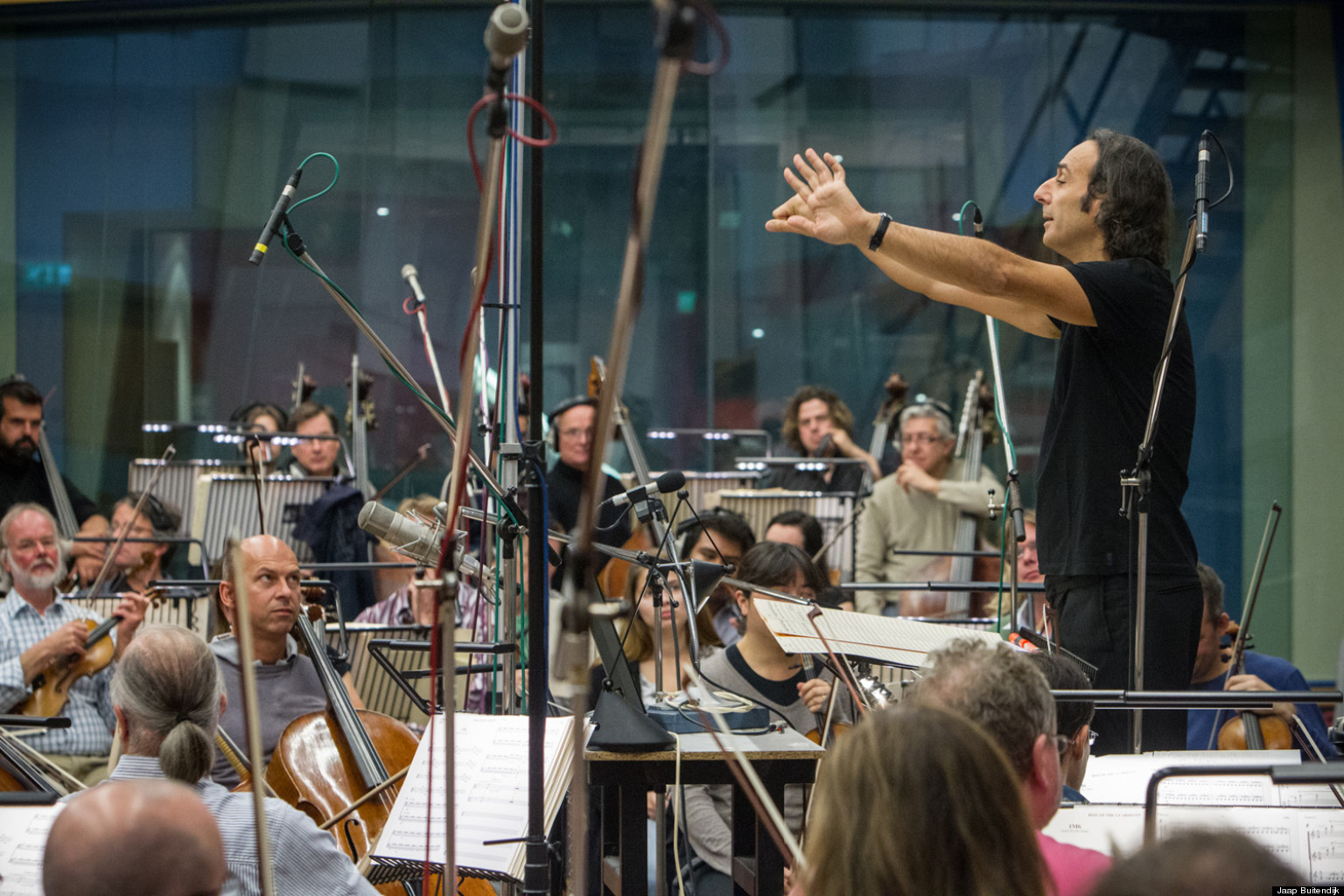
I watched Alexandre Desplat win his first Academy Award this evening. When they announced the winner, I thought to myself oh, Desplat won again and it wasn't until I looked up his Wikipedia page that I realized that it was his first award after seven nominations, which, to say the least, must have been a frustrating road to success.
I was googling around about Desplat's career, and I came across this page at the VSL site where you can view a fairly in-depth interview with him. Its full of all sorts of interesting information, but the part that stuck out to me was at the very beginning, where they ask Desplat-- who's filmography is incomprehensible in its enormity-- how he is able to do so much film scoring, and he simply answers that its the only thing he does. A typical workday apparently starts at 6:30am and ends at midnight. "I don't really have a life," Desplat says to describe his routine.
Of course, Desplat does have a life-- its just a life that's consumed with producing beautiful, well-crafted music, and nothing else. He's well on his way to becoming the film composer version of Sukiyabashi Jiro, a Japanese sushi chef who has elevated his culinary art so high that there's no one left to compare him to. With that kind of perspective, it seems to me that it is the Desplats and Jiros of the world that actually have lives-- lives worth living, at least.
I see a lot of people who want to write music for a living, and I get a fair number of people asking me-- a composer that's really only done a small amount of work, all things considered-- what my advice is for young composers. I've been meaning to write a blog post about it so that I can reference it rather than repeating myself over and over in email, and I guess this post is as good as any. So here goes:
Write every day. Never stop writing. Never stop making music. Every day you aren't composing, you're becoming a worse composer than the day before. It isn't easy (and I'll be honest, I haven't figured out how to be as consistent as I tell others to be), but it is the only way you will master the complex skills that it takes to produce a genuinely effective piece of orchestral music.
Write every day.
People will tell you to go to school and learn your art, and they're right, but there are a million composition majors in the world, but there aren't a million professional composers. They'll tell you to listen and learn from the greats, and they're right, but there's a lot more people visiting IMSLP and buying classical records every day than there are successful composers working in the game industry or Hollywood.
Write. Every. Day.
People will tell you that you need great equipment, and that does help, but all the sample libraries, computing power, and audio gear in the world can't make a bad melody into a good one. They'll tell you that you have to find the work first, then you can start learning how to be a composer, but there's a lot fewer job openings than there are days in your life.
Write.
Every.
Day.
It seems scary-- like you're going to give up too many other things to meet your writing goals, but you won't. Like Desplat, you're not giving up your life, you're finding it. I can attest that there's nothing as satisfying as being good at what you do-- especially when "what you do" is to produce something beautiful, moving, and, if you're lucky, important. So make something beautiful today.
And then do it again tomorrow.

Not Starbound. Not even sure what this was even for.
About Sheet Music
Over the past couple of weeks, I've received a lot of inquiries about Starbound sheet music. I'm really excited that people are interested enough in my music to want to play it themselves, and, for the most part, I think the music is easy enough to be widely accessible if there were sheet music available.
Unfortunately, it isn't, and probably won't be for awhile. While I'd love to make the music available right now, that process is simply too time-consuming given my current schedule.
Why?
Producing a score to a videogame is a complex process that goes beyond just "writing notes". Most of the Starbound scores do start out as a small handwritten sketch, which I then input into Logic using a keyboard, a process that I have documented during livestream events wherein I wrote several cues for Starbound live. You can still view those videos on my YouTube channel.
The "score" for those cues is often barely legible, and is usually driven by MIDI data that can't show up on a written score. For example, while in a regular score, you can tell an instrumentalist (like a violin player) to get louder simply by writing a crescendo symbol, in a virtualized environment, I have to use MIDI controller envelopes like CC11 and CC1 to tell the violin track to increase in volume. Special technical effects like pizzicato, spiccato, etc., actually use different tracks with specific patches loaded-- which on a score shows up as a different instrument, even though on real score pizzicato and bowed notes live on the same staff, with a simple "pizz" or "arco" articulation mark telling the player where to switch.
Even "simple" tracks like M54 have barely legible scores, as I typically program them into my DAW (Logic) and then tweak velocity and other data in my performance. This is what the score to M54 looks like if I just load up the file:

Compare that to the notation for On the Beach at Night, which was originally conceived not as a track for Starbound, but as a piece for SSA choir:
The process of turning the top score into the bottom score basically means re-writing the entire cue from scratch, which isn't as easy as it sounds-- at this point I don't remember most of the details about each particular piece on the Starbound soundtrack, and I'd essentially be transcribing my own music. Its doable, but very time consuming. Seeing as I'm currently involved in several game/film projects at the moment, I probably won't be able to find time to actually go through this process any time soon. I do hope to in the future-- I'd love to have a medium-difficulty set of pieces for Starbound transcribed for piano available. That future, however, is probably a ways off.
In the meantime, I invite any fans of the Starbound soundtrack to transcribe any of the game's music if they so wish. Nobody's going to come after you or try to sue you-- we're just an indie game developer and a very indie composer. I would ask that you not sell transcriptions of Starbound music, but if you want to sit down and write out your favorite cue, I'm not going to stop you-- in fact, I encourage it.
So that's that. I'm sorry I don't have enough time to build the kind of sheet-music collection I know our fans deserve, but I am happy to let anyone in the community who is passionate enough about our game make their own versions. An official one, unfortunately, will have to wait.

Hey, I made another album!
"Mirror"
On the Beach at Night: Sheet Music
I've had several people ask me to post the sheet music to "On the Beach at Night". So, I will!:
The Apex
I've always thought the Apex cue should sound like a bunch of gorillas that smashed up a DeBeers commercial, so that's what we went for:
If you'd like to watch the marathon 4-hour composing session, including the grunts, here's the stream:
(Note the audience participation! Thanks to @Sacheverell for the use of his voice!)
Floran!
Tonight, I started (and finished) work on a new Floran cue. Still don't have a title, and we're going to be sending it over to Solatrus to see what magic he'd like to add, but in the meantime, here's the first export:
You can watch the composition process here:
Prism of Love
I have a friend named Brian Lemos-- who I went to college with-- who always beat me out at college film festivals for "best score". And for a reason-- this guy writes amazing music. He recently wrote a score to one of the Seventh Spectrum Films called "Prism of Love". It has fantastic music-- seriously, we're talking like, Michael Giacchinno 's score to Up, only better:
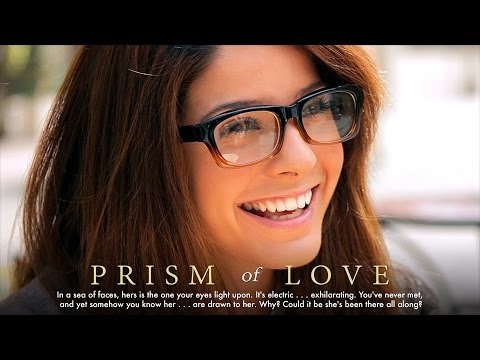
I know, right?
Threnody
"Valley of Mist"
A few years ago, I worked with some filmmakers on a set of interconnected stories that were to be told in a series of short films. I wrote some music for titles, and scored a few of the films. That was more than 2 years ago, but those films are finally starting to come online. The first two are up on Hulu, including "Valley of Mist", which features my music:
Prairie Sunset
Some of my recent work-- a setting for Baritone and Piano of Whitman's poem "A Prairie Sunset":
Livestreaming Non-Starbound Work
So when I'm not working on Starbound, I'm usually working on royalty-free tracks for libraries like AudioJungle, AudioMicro, or Pond5. I think I've figured out how to get streaming back up and running again, and thought I'd stream some of my work on that:
Hylotl
Someone mentioned that I'd never posted the revised Hylotl cue. Let's fix that too!